BikeSmith data
How Dubai heat affects your bicycle
How we are measuring it
We are logging the condition of every bike that comes to us after a summer standing, recording where it was stored, for how long, and which components had failed. Balcony, covered parking, and indoor storage are tracked separately. Figures will be published here once the sample is large enough to be worth anything.
Most advice about bicycle maintenance is written for temperate climates, where the enemy is rain and road salt. In Dubai the enemy is heat, UV and sand, and the failure pattern is genuinely different.
The most useful thing to understand is that a bicycle here degrades fastest when it is not being ridden. Through the summer, bikes sit still in temperatures that would be considered extreme storage conditions for rubber and lubricant. Riding at least keeps grease circulating; standing does not.
What heat actually does
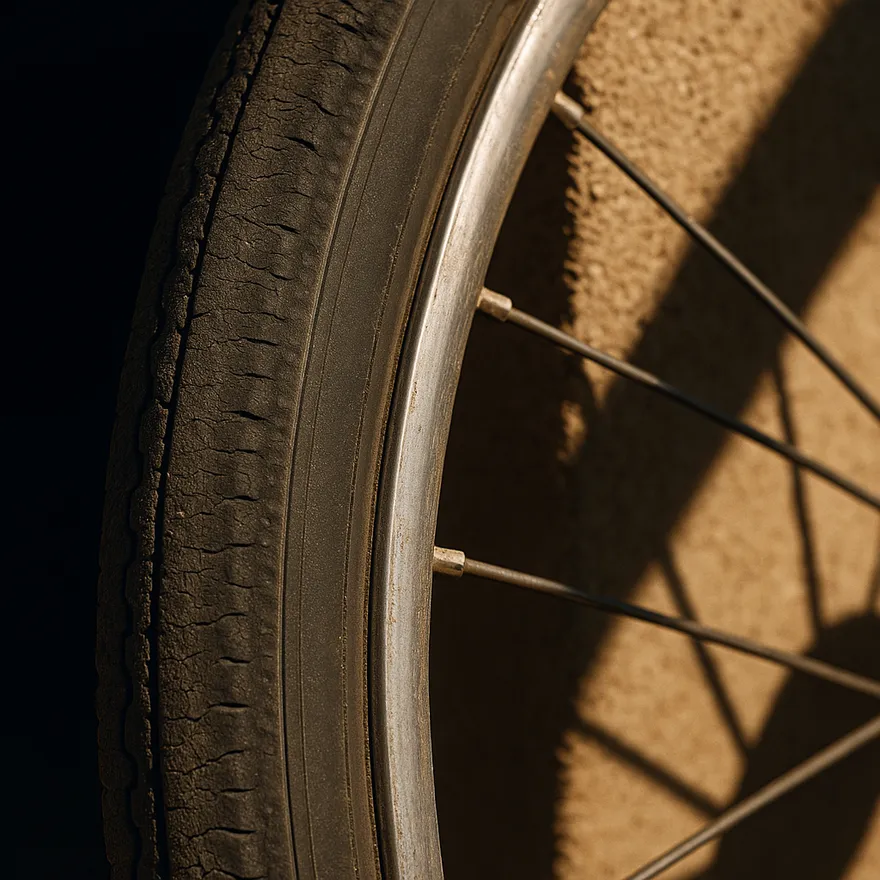
Rubber perishes. Tyres, tubes and seals all rely on plasticisers that migrate out faster at high temperature, accelerated further by UV. This is why a tyre stored on a balcony can look perfectly serviceable, hold air, and then fail on the first ride of the season.
Lubricant thins and moves. Bearing grease has a working temperature range. Sustained heat thins it, and thinned grease migrates away from bearing surfaces under gravity. A hub that felt fine in April can be dry by October without a single kilometre being ridden.
Sealant dries out. Tubeless sealant works by staying liquid. Manufacturer intervals are written for temperate conditions, and in our experience they do not survive contact with a Dubai summer.
Pressure swings are large. A tyre inflated indoors and then parked in sun sees a real pressure rise, and the cycle of heating and cooling accelerates loss through both the tube and any small leak.
What we are measuring
We are collecting our own figures rather than repeating manufacturer intervals written for Europe. Specifically: how long components actually last here, how much storage location changes that, and how far tyre pressure really drifts between a cool morning and hot asphalt.
That work is running now. When there is enough data to say something honest, it goes on this page, and on the component lifespan, tyre pressure and chain lube pages.
What to do about it in the meantime
Store the bike indoors if you possibly can. It is free and it is the single largest improvement available.
If it must be outside, keep it out of direct sun and cover it. UV does more damage than heat alone.
Before the first ride after a long stand, check two things properly: squeeze both brake levers hard, and inspect the tyre sidewalls in daylight for fine cracking. Those are the two failures that actually hurt people, and both are invisible at a glance. The full list is on what to check after months unused.
Common questions
Is it bad to store a bike on a balcony in Dubai?
Yes. It is the hardest thing you can do to a bicycle short of leaving it outdoors permanently. Sustained heat combined with direct UV attacks tyres, cables, saddle, bar tape and any plastic component. Indoor storage costs nothing and makes a dramatic difference.
Does heat damage a bicycle even if I do not ride it?
Yes, and standing is often worse than riding. Riding at least keeps lubricant moving through bearings. A bike standing in heat has grease thinning and migrating away from where it is needed, with nothing circulating it back.
What fails first in Dubai heat?
Rubber and lubricant. Tyres and tubes perish, tubeless sealant dries out, chain lube thickens or evaporates, and bearing grease thins and migrates. Cables seize if sand entered the housing before the bike was put away.
Want us to look at yours?
We come to you anywhere in Dubai, quote from a photo before travelling, and fix most bikes in one visit.
Get a price on WhatsApp