BikeSmith data
How long bicycle parts really last in Dubai
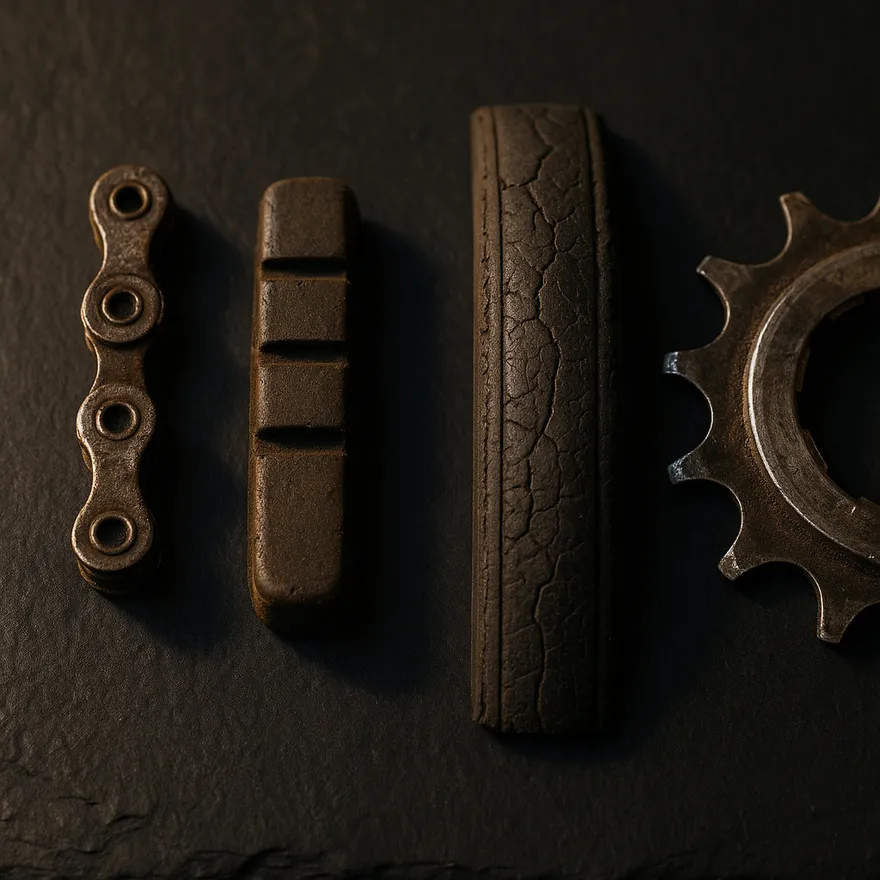
How we are measuring it
Every component we replace is logged with its measured wear, the rider's estimated distance, where the bike is stored, and whether it is ridden mostly on desert tracks or city roads. Over time that gives a real distribution for each part in this market rather than a single number copied from a manufacturer's temperate-climate figure.
Every service interval you have read was measured somewhere else. Manufacturers publish figures based on temperate testing, where the assumptions are moderate temperatures, occasional rain, and wear that accumulates with distance ridden.
None of those assumptions hold here, and two of them fail badly.
Two different clocks
A bicycle in Dubai is wearing out on two independent clocks, and most maintenance advice only tracks one.
The distance clock is the familiar one: chains stretch, brake pads wear, bearings accumulate hours. Sand accelerates this, particularly on the drivetrain, because abrasive particles inside a chain do exactly what a grinding paste would.
The calendar clock is the one that catches people out. Tyres perish, sealant dries, cables seize and grease migrates whether or not the bike moves. A bike that covered 200 km last year and spent the summer on a balcony can need more work than one that covered 3,000 km and lived indoors.
That second clock is why "how many kilometres between services?" is the wrong question in this market, and why we ask where a bike is stored before we ask how far it has been ridden.
What we are measuring
Every component we replace gets logged: measured wear where there is an objective measure, the rider's estimated distance, storage location, and whether the riding is mostly desert track or city road.
Over a season that produces something no manufacturer chart can: a real distribution for this market, split by the two things that actually drive it here.
The parts we most want honest numbers for:
- Chains: desert versus city kilometres, measured by elongation
- Tyres: indoor versus balcony storage, measured by sidewall condition
- Tubeless sealant: how far short of the stated interval it really falls
- Cables and housing: how much sand ingress shortens their life
- Bearing grease: how a summer of standing compares to a season of riding
Why the table is empty
Because we have not finished. Publishing a plausible-looking set of intervals today would be straightforward and would probably rank, but you would have no way of knowing we made them up, and neither would anyone quoting us later.
The method is above so you can judge it. The numbers follow.
Common questions
Do bike parts wear out faster in Dubai?
Yes. Drivetrain parts almost certainly do, because blown sand is abrasive and gets into the chain. Rubber and sealant degrade faster from heat and UV regardless of distance ridden. What we do not yet have is a defensible number for how much faster, which is what this study is for.
Why not just follow the manufacturer's service interval?
Because those intervals are set in temperate conditions and assume the wear mechanism is normal use. Here, a bike can degrade significantly while standing still through a summer, which no distance-based interval captures.
What wears out fastest here?
On evidence so far, chains on bikes ridden on desert tracks, and tyres and sealant on bikes stored outdoors. Those are two different mechanisms (abrasion and heat ageing), and a rider can be badly affected by one and not the other.
Want us to look at yours?
We come to you anywhere in Dubai, quote from a photo before travelling, and fix most bikes in one visit.
Get a price on WhatsApp